

[think] inspiration
We can’t predict the future. But with the right inspiration we can better expect and prepare for it.
T H E A R T & S C I E N C E O F F O R E S I G H T
Foresight is the discipline of exploring, anticipating, and shaping the future by examining trends, risks, emerging issues, and their potential implications.
Foresight is not about predicting the future; it explores plausible futures along with the opportunities and challenges they may present.
Business foresight is grounded in research and data analytics along with sociological and psychological theory.
T H E B U S I N E S S O F F O R E S I G H T
Foresight gives businesses a plausible vision of the future by analyzing the drivers behind relevant trend shifts. Its purpose is to empower strategic decision-makers with a clearer vision of what’s to come in 2 to 5 years.
-
Foresight doesn’t predict the future, nor does it provide precise forecasts. Its purpose is to show the big picture of change and uses a logical storyflow to connect the dots from today to tomorrow.
Forecasting relies on constant updates to be accurate and is better for short-term guidance. The farther the forecast the more unreliable the output, like a weather forecast.
-
Foresight research examines the “whys” behind the “whats” to determine the root cause of behavior change. Root cause understanding enables proactive decisions (vs, reactive decisions, which occur when people only understand the “whats)
-
A trend is a cluster of behavioral changes. It is one of the strongest signals that a shift is happening.
-
Business foresight targets those who make broader and longer-term business decisions because highly tactical and short-term decision-makers need insights and forecasting, not foresight
-
This is generally the typical sweet spot for most businesses to think ahead and plan without being so far ahead it’s irrelevant. Some businesses, such as energy and manufacturing, need a 10+ year runway.
The Four Steps for Business Foresight
-
This foundation is the most important. Understand all the basic parameters (the what, the why, the how, and the how many) what normal behaviors are for a certain situation (e.g. how we communicate, how we drive, how we work, what we do to relax).
-
Once you know what the normal is, you can easily identify signals of change. What is a deviation from normal behavior? How often is it happening? In what ways is it happening? The more signals you identify and the greater the frequency and intensity, the stronger the change.
-
Once signals are identified among a population segment, investigate the causes of change to determine duration (short-term vs. long-term, fad vs. trend) and intensity (speed of change).
-
Align the story of change (what was normal, what is changing, why it is changing) with the business goals, leadership assumptions, and blind spots to create a range of scenarios, focusing on the most plausible. Ideate if/then action plans for each scenario.
I D E N T I F Y T H E C H A N G E
All trends follow an S-Curve

Businesses seek out new solutions at specific times of uncertainty
Stage 2: “Is this going to be The Next Big Thing?”
Stage 3: “Is it time to jump on the bandwagon?”
Stage 6: “Is there a new market for us?” or “Is our business in danger?”
Businesses continue as usual when the future seems certain
Stage 1: “This isn’t real or relevant.”
Stage 4: “This run is over.”
Stage 5: “We know everything there is to know.”
B U T U N C E R T A I N T Y C A N L E A D T O
The adaptability paradox:
When we most need to learn and change, we stick with what we know, often in a way that stifles learning and innovation
(McKinsey)
We saw the Adaptability Paradox during the pandemic: With societal lockdowns and an uncertain future, risk-taking instantly declined
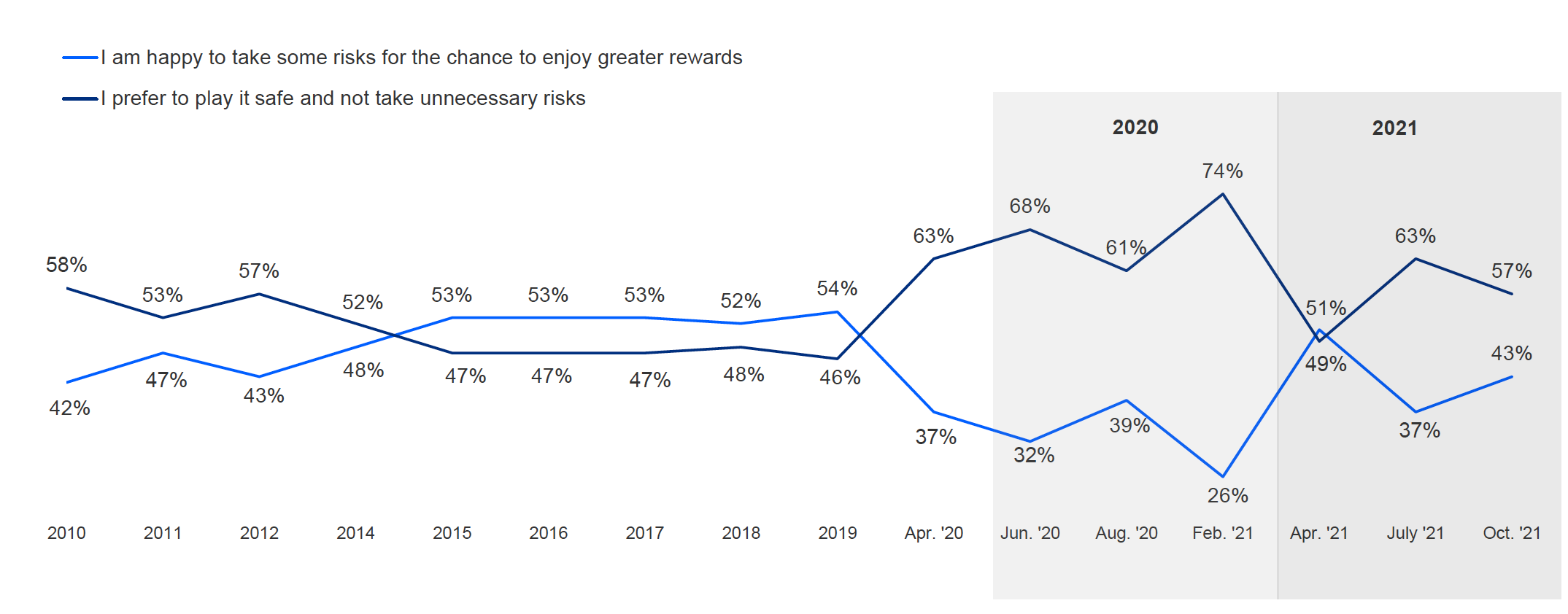
Source: Kantar US, 2022
The primary purpose of business foresight is to de-risk ambiguity and clarify uncertainty to make better decisions about the future
Market Insights & UX Research
Behavioral
How people act
Attitudinal
What people think
Sentimental
How people feel
Business Foresight
Contextual
What, why, and how people are influenced
Directional
Degree and rate of change

For decision-makers who want to look ahead
01
During good times when markets are stable and leaders are more open to risk-taking, foresight is best used to help de-risk future investments or as a pathfinding function to uncover business opportunities from emerging trends.
02
During bad times when markets are unstable and leaders are more risk-adverse, foresight succeeds when used as a tunnel to the guiding light (instead of being the guiding light) by grounding itself in core human values that are stable and persistent.
03
Foresight feeds forecasting. Highly quantitative minds and linear thinkers can have difficulty with ambiguity, so foresight can be structured as an input to clarify assumptions, leading to more robust forecasting models.
04
The misinterpretation of signals is due to limited understanding of what is normal today. Without a firm grasp of normal beliefs, behaviors, and values, it’s easy to jump to ungrounded conclusions and find false positives. Collaboration with market insights and UX research teams is important to have a strong foundation.

Fred Kim was the head of business foresight at Meta where he led research efforts for the Metaverse Acceleration Program and the largest study in the world on pandemic-driven changes in relationships.
He also led the Society & Technology Research Group at Mercedes-Benz Research & Development where he led strategic foresight and trend forecasting for future vehicle development, including the W223 S-Class, X223 Maybach, and V297 EQS.
He identified new cultural and consumer trends with a 98% accuracy rate and qualified the rise of Progressive Luxury, a new luxury buyer archetype that’s now prevalent in the market today. In 2012 he was the first foresight leader in the industry to correctly forecast Millennial trajectories in ownership and luxury signaling.
His business foresight foundations has been featured at the Broad College of Business at Michigan State University and Brand in Communications program at The City College of New York.
Collaborate with studio f.k
Consultation and advisory services available for business foresight integration and organizational development